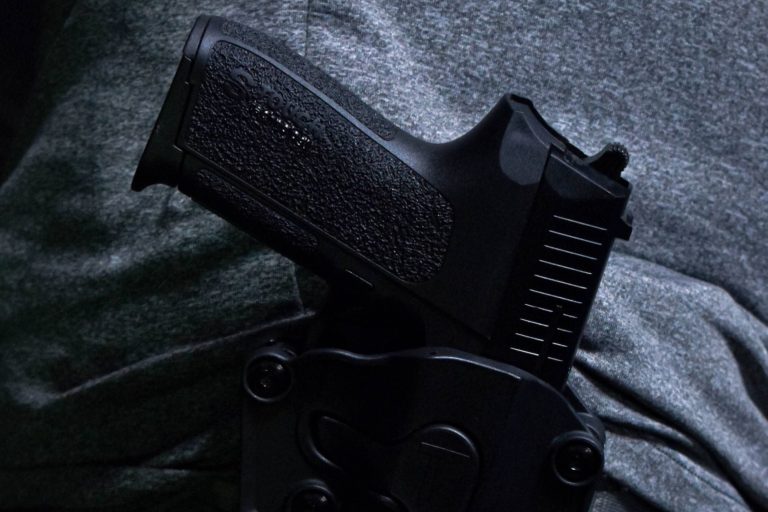
So we’ve spent all of our money and time picking out the perfect defensive pistol for ourselves. We’ve agonized over the correct caliber, options, read all of the internet chatter, spoke with “George the Gun Guy” down the street, read the latest “Jim’s Gems” blog article, taken into account all of the variables about us and our environment. Now, we discover that sometimes it’s hard to conceal our best pistol pick 24/7, 365 days per year. What is a person to do?
Well, the next logical choice is to select a smaller gun. If you have read my first article on selecting a Defensive Pistol, you may remember that I do not like small guns Sam I am. I still don’t like small guns, but sometimes a small gun is better than no gun at all.
You will also remember that I doubted whether you would be able to get by with just one gun. Generally, most law enforcement officers, armed citizens, and other professional gunmen have two handguns that they carry for self-defense use. In some cases, an officer or armed citizen may need a back-up gun in case their primary pistol goes down or is no longer in their possession. In other cases, they may feel the need to have a smaller weapon that can be more easily concealed due to clothing or other issues.
My back-up, aka hide-out, aka “Small Gun” selection criteria is practically the same as my primary or “Big Gun” with a few exceptions. Let’s look a few of the criteria:
Selection Criteria
- Reliability: If the handgun will not fire 500 rounds without malfunction, for you, its performance is suspect for working when you need it to work the most.
- Shootability: Technical term I use to describe if you can actually hit anything with this pistol, at speed and while shooting for precision accuracy.
- Reasonable accuracy with defensive hollow point ammunition: Generally around 6″ groups, from a rest, at 25 yards.
- Pointability: Another technical term I use to describe if the handgun naturally points, for you, at the target when you have the proper master grip on the handgun.
- Easy to use controls: I avoid unusual magazine release systems, strange safety levers and other non-ergonomic controls.
- Smooth edges: Not to abrade clothing and skin.
- Easy to repair: Parts and accessories are available in most full-service gun shops, at least nationwide.
- Compatibility: With our primary defensive pistol. This is part of the overall system.
While all of these items matter in a defensive gun, I find that reliability, shootability and compatibility are the main things I look for from my back-up or small defensive handgun. Now that we know what the criteria is, let’s look at those handguns and calibers we know to perform very well for the majority of end users. The models I have seen perform the best, are as follows:
- Glock models 26, 27, 42, 43, 43X
- Heckler & Koch VP9 SK a1
- Sig Sauer models P239, P230/232, P365…with reservations on caliber and controls
- Smith & Wesson M&P Compact, Shield and EZ pistols, preferably from the 2.0 series
- Smith & Wesson revolvers, J or K frame, with 2-3″ barrels, chambered in 38 Special
- Springfield Armory Hellcat
- Colt Cobra (D frame) revolvers for those carrying Colt revolvers already, chambered in 38 Special
Yet, another short list of suitable guns to get the Arm-chair Commandos all excited. If your favorite blaster, caliber and/or brand is not listed, there’s a reason. It may be the bore axis is high, making it harder to shoot well? It may be that the pistol is generally not reliable, regardless of what some gun writer or internet expert says. It may be the pistol has an unusually heavy trigger pull? Maybe it’s brand new model, without a proven track record of performance? Trust me, there’s a reason. See the listed criteria to discover why.
Caliber Considerations
I would recommend suitable calibers as being: 380 ACP (with reservations due to lack of power), 38 Special, 9mm (9×19) and 40 S&W. The 45 ACP is not listed due to the length of the cartridge, causing issues with reliable function in small semi-automatic pistols, size of the overall guns, weight in smaller models, limited magazine capacity and heavier felt recoil. Contrary to popular opinion, I have never found small 45 ACP pistols to be reliable.
While the 357 Magnum cartridge is excellent in longer barreled guns, it has limited performance (velocity) gains in 2-2 1/2″ barreled guns. Yet you still get the excessive muzzle blast, muzzle flash due to unburned powder and heavy recoil of the 357 Magnum, without any gain in performance over 38 Special +P. Generally, in 2 1/2″ barreled, 357 Magnum revolvers, we have seen a velocity difference of less than 75 fps between 38 Special +P, with the same weight bullets, from the same manufacturer. To me, the minor velocity gain is not worth the obnoxious blast and recoil of the 357 Magnum cartridge.
Now, let’s talk about the 380 ACP in a back-up/small gun and my personal reservations. First, the cartridge has limited muzzle energy (power). If we remember from my article on Cartridge Selection, we must have enough penetration to reach our attacker’s vitals…even through windshields, doors, clothing, etc. While I don’t want to get shot with a BB gun, I question whether the 380 cartridge has enough power to finish the job we start. Second, many 380 ACP pistols work in a “blow-back” operation. This gives them as much felt recoil as a locked breech 9mm. Third, many 380 ACP pistols are not reliable. All this being said, some people do not have the hand strength and experience to control the smaller sub-compact 9mm pistols. Thus, the reason why I recommend the 380 ACP for this limited application. We now go back to “some gun, is better than no gun.” You just need to realize the limitations of the cartridge.
The Reality of Smaller Handguns
You’ll notice that I accept less accuracy from these smaller guns, but not much less. It is a fact that shorter barreled (shorter sight radius) guns are harder to shoot well, since we cannot see our sight error as easily. Note that I did not say they were not accurate. They are accurate, but the smaller guns generally have heavier trigger pulls, smaller grips, more felt recoil, heavier recoil springs, etc. All of these things hurt our ability to shoot the handgun well.
Though it is listed last in the selection criteria, I have come to believe that your primary handgun should be compatible, or the same, as your smaller handgun. For example, if you already carry a Glock model 19, you should look at the Glock model 26 or 43, as a suitable back-up. If you are carrying a Smith & Wesson revolver, you should be looking at the Smith revolver in the same platform only the smaller J frame models. Smith & Wesson M&P pistol owners should look at the M&P Compact and/or Shield series of pistols, as a suitable back-up to their primary handgun. You get the idea.
By sticking with the same type of handgun, the manual of arms, trigger pull, safeties, cylinder release, cylinder rotation, grip angle, etc., is all the same on both guns. This reduces your reaction time during a stressful event, increases your proficiency on both guns when you train with either model, as well as makes it easier to keep spare parts since many of the parts on the big gun are similar to that of the small guns. In some cases, magazines from a larger model pistol will fit into the magazine well of a smaller one and properly function. Remember, this is your system.
So for you Dr. Seuss fans, I don’t like small guns Sam I am. Not on a bus, not on a train. Even if TSA says it’s okay! I still don’t like small guns Sam I am.
Try them, try them and you may…
Jim